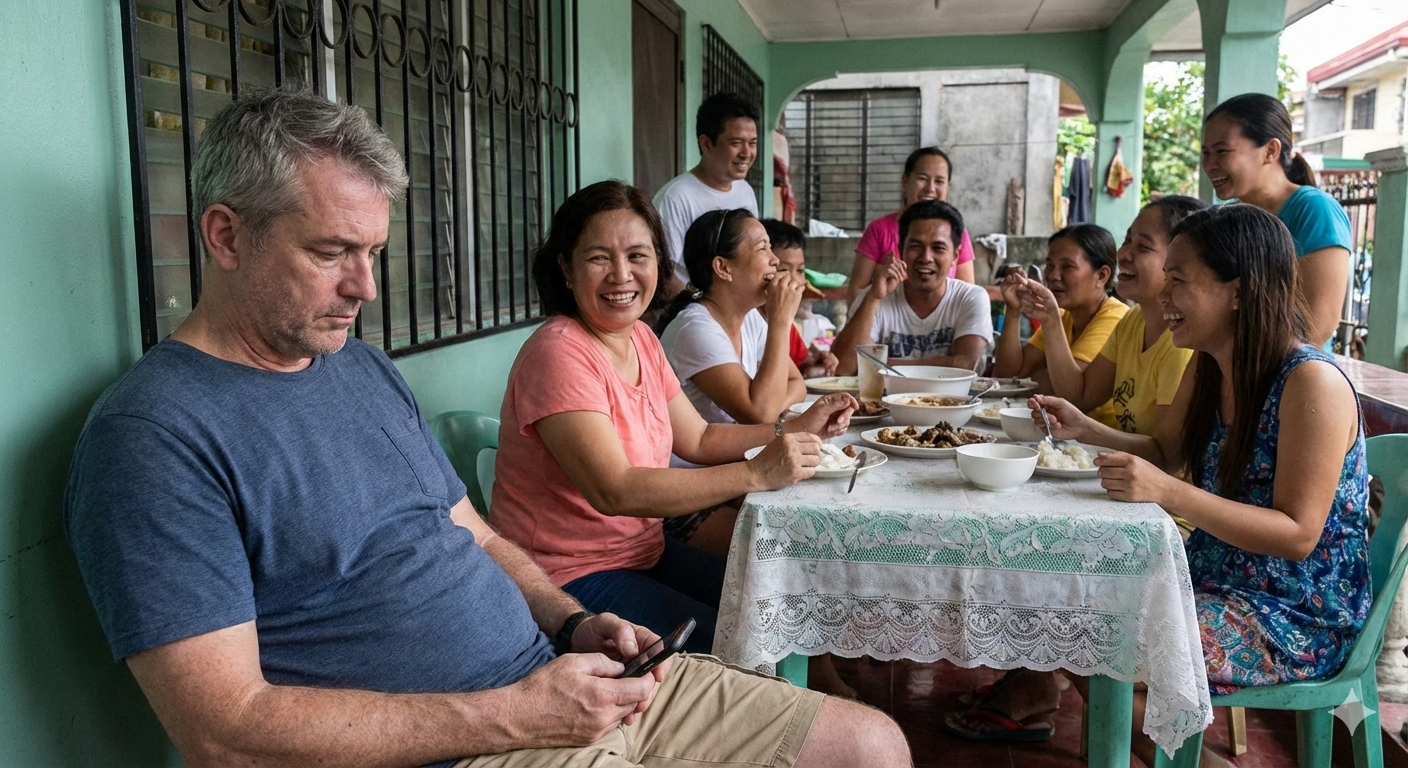

At a Christmas party, everyone was relaxed and loud in the best way.
My student watched his father-in-law drinking happily. Neighbors were gathered nearby, holding Red Horse, swapping stories in Cebuano. Laughter kept bursting out—inside jokes, teasing, the kind of talk that makes a room feel warm.
And he was there… but not really.
Because he didn’t understand Cebuano, he did the only thing that didn’t require language: he stared at his phone and drank quietly. Someone would notice and kindly switch to English to include him. It helped—for a minute. But it never lasted. The group naturally drifted back to Cebuano, and he was outside the circle again.
Later he told me:
“Everyone is kind. But I’ve never had a deep conversation with family or friends in Cebuano. So I’ve never felt that ‘from-the-bottom-of-my-heart’ kind of fun.”
That sentence hits hard because it’s not about grammar. It’s about belonging.
The good news is: you don’t need to be fluent to escape this.
The fastest learners don’t start by collecting more words. They start by earning a role in real conversations—using a few simple Cebuano tools that work even when you’re a beginner.
1) Drop the wrong goal: Fluency
Fluency is a long-term outcome. Belonging is a short-term win.
Replace your goal with these:
- “I want to react naturally, even if I don’t catch everything.”
- “I want to stay in the flow instead of going silent.”
- “I want to share the moment, not just watch it.”
Now let’s build the three skills that get you into the circle.
2) The only 3 things you need first to get into the circle (with Cebuano you can use today)
Skill #1: Reactions — the “I’m with you” signal
Reactions are your fastest entry ticket because they work even when you didn’t understand every word.
Here are beginner-friendly Cebuano reactions you can “drop” into the moment:
Empathy / agreement
- Bitaw. = “Exactly / That’s true.”
- Mao gyud. = “That’s really true.”
- Okay ra. = “It’s okay / No worries.”
Surprise
- Tinuod? = “Really?”
- Ha? / Hala! = “Huh? / Oh wow!” (light surprise)
Praise
- Maayo! = “Good!”
- Nindot! = “Nice!”
- Gwapo / Gwapa! = “Handsome / Pretty!” (use carefully, but it’s common)
Laughter / fun
Key rule: short beats perfect.
Don’t wait until you can say something “beautiful.” One small reaction keeps you visible.
A small trick that works at parties:
Even if you only caught 20%, you can still react to the emotion.
- People laugh → “kataw-anan kaayo!”
- Someone boasts → “Maayo!” / “Nindot!”
- Something surprising → “Tinuod?”
That’s how you stay inside the moment.
Skill #2: Questions — the beginner’s unfair advantage
You don’t have to be the storyteller. You can be the person who invites stories.
Here are practical Cebuano questions that are short and conversation-friendly:
Safe-entry questions (step into the circle)
- Unsa’y inyong gistoryahan? = “What are you talking about?”
- Unsay istorya? = “What’s the story / What’s up?”
- Unsa imong giinom? = “What are you drinking?”
- Lami? = “Is it good/tasty?”
Conversation-extending questions (get longer answers)
- Kumusta man? = “How was it?”
- Ngano man? = “Why?”
- Unya, unsa man nahitabo? = “Then what happened?”
- Unsa’y pinakaganahan nimo? = “Which do you like best?”
Party tip: don’t prepare questions for “all topics.”
Prepare for one setting—food, drinks, memories, family updates. That’s where Cebuano naturally repeats.
Skill #3: Bridges — your “don’t disappear” toolkit
The real danger isn’t “I don’t understand.”
It’s: you don’t understand → you go silent → the topic moves → you get left behind → you reach for your phone.
These bridges keep you connected:
Repeat
Slower
Meaning check
Keep it light and quick. Bridges protect the flow—they don’t stop it.
3) The fastest route: get a “role” in 7 days (with Cebuano mini-scripts)
This plan isn’t designed to make you “good at Cebuano.”
It’s designed to create a real win fast: at the next gathering, you join the circle.
Step 0: Choose one “battlefield”
Pick one situation where you most want to belong:
- dinner at home
- weekend family visit
- small drinking get-together
- video calls with family
One battlefield first. That’s how you stop freezing.
Day 1: Choose 10 reactions (train instant output)
Your goal is automatic release, not “studying.”
Pick 10 from these (example set):
- Bitaw. / Mao gyud. / Okay ra. / Tinuod? / Hala! / Maayo! / Nindot! / Lingaw lagi! / Ayaw oy!(“No way!” casual) / Sige.(“Okay/Go ahead”)
Night mission (real life): use just one reaction once.
Even one “Bitaw” is a win.
Day 2: Build 5 questions (3 extend + 2 safe entry)
Use this exact structure:
- 3 extend: Kumusta man? / Ngano man? / Unya unsa man nahitabo?
- 2 safe entry: Unsa’y inyong gistoryahan? / Unsa imong giinom?
Then turn each into a mini-sequence so you don’t freeze after they answer:
Question → Reaction → One tiny follow-up
Example:
That’s participation without pressure.
Day 3: Lock in 3 bridges (your anti-silence reflex)
Choose one from each category:
Practice out loud for 30 seconds.
Your brain needs a default action for “I didn’t catch that.”
Day 4: The “60 seconds only” rule
Beginners fail when they force long participation. So do the opposite.
Join for one minute, then step back.
In that minute, aim for:
One minute is enough to prove to yourself: “I can enter.”
Day 5: Repeat one pattern 3 times (do not add new sentences)
This is where learners sabotage themselves: “Today I’ll learn new phrases.”
Instead, repeat one pattern three times:
Reaction → Question → Reaction
Example loop:
Repetition creates reliability. Reliability creates confidence.
Day 6: Use the safest structure: “One line + one question”
Use Cebuano that is short and survivable.
One line (feeling/opinion) + one question (pass the ball back)
Examples:
- Lingaw lagi. (This is fun.) + Unsa’y inyong gistoryahan? (What are you talking about?)
- Lami kaayo. (So tasty.) + Ikaw, ganahan ka? (How about you, do you like it?)
Short beats perfect.
Day 7: Show up as the “reaction person”
Stop trying to be the main speaker.
Your job:
- react (Bitaw / Tinuod? / Nindot)
- laugh at the right moments (Katawa-a)
- ask one question when you can
- use a bridge instead of going silent
That’s already a different life than “scrolling on your phone with a drink.”
4) Three traps that keep you stuck outside (with Cebuano fixes)
Trap 1: Starting with vocabulary lists
Vocabulary helps later, but vocabulary alone doesn’t give you a role.
Fix: reactions + questions + bridges first. Then steal words from real conversations you’re already joining.
Trap 2: People switching to English (kind—but risky)
English helps, but it can lock you as “the English person.”
Fix: thank them, then gently return to Cebuano with you included.
Use one of these lines:
- Salamat. Pwede Cebuano lang ta, palihog? Nagtuon ko.
= “Thanks. Can we use Cebuano, please? I’m studying.” - Pwede hinay-hinay ug Cebuano? Nagpraktis ko.
= “Can you do Cebuano slowly? I’m practicing.”
Short, friendly, no drama.
Trap 3: The “I didn’t understand, so I quit” habit
Silence → left behind → shame → withdrawal → phone.
Fix: when you miss something, don’t disappear—bridge.
Conclusion: You don’t want fluency—you want to laugh with them
At that Christmas party, my student didn’t want perfect Cebuano.
He wanted to stop feeling invisible.
He wanted to share the warmth, not just watch it.
That starts with three things—reactions, questions, and bridges—and a simple 7-day plan to earn your role in the conversation.
If you do only one thing today:
Choose 10 reactions and commit to using just one tonight.
That’s how you step into the circle.


Comment