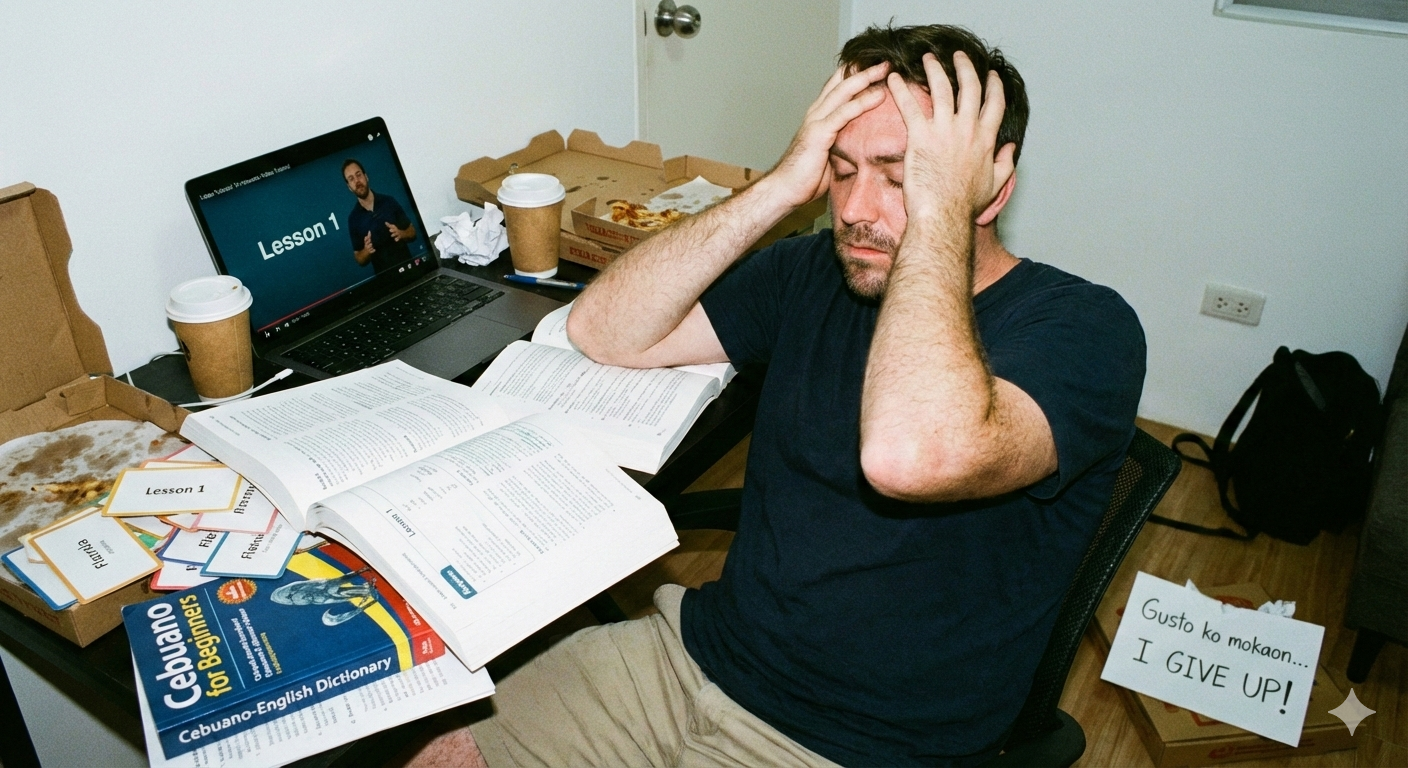
Many English speakers start learning Cebuano with good intentions.
They buy a well-reviewed textbook.
They sign up for an online course.
They watch YouTube explanations of grammar.
And then… they quit.
Not because they’re lazy.
Not because Cebuano is “too hard.”
Not because they lack language talent.
They quit because the way Cebuano is usually taught works against how English speakers actually learn.
This article explains:
- Why “good” Cebuano resources often lead to frustration
- Where English-based learning logic breaks down
- What to do instead — step by step, in practical terms
Part 1: Why Good Resources Still Lead to Failure
1. Structured Self-Study Materials Teach the Wrong Things First
Most Cebuano textbooks and self-study courses are:
- Linguistically accurate
- Well organized
- Clearly explained in English
On paper, they look excellent.
The problem is order.
They usually begin with:
- What verbs are
- How focus works
- How case markers function
But what learners actually need first is much simpler:
How do I survive in a real conversation without freezing?
As a result, learners:
- Understand explanations
- Can talk about grammar
- But cannot participate in conversations
Understanding ≠ usability.
2. Verb Focus and Case Markers Are Over-Explained
Cebuano’s defining features — verb forms and markers like ang / sa / og — are usually taught through:
- Definitions
- Categories
- Exceptions
For English speakers, this is dangerous.
English speakers tend to believe:
“If I can explain it, I understand it.”
So they:
- Keep asking why
- Refuse to move forward without full clarity
- Get stuck in analysis instead of usage
This creates analysis paralysis, not fluency.
3. English–Cebuano Translation Becomes a Crutch
Most materials rely on direct translation:
- English sentence
- Cebuano equivalent
This trains learners to:
- Think in English first
- Translate mentally
- Speak slowly and hesitantly
In real conversation, this leads to silence.
Cebuano does not map cleanly onto English.
Trying to force a one-to-one correspondence guarantees frustration.
4. Audio Is Treated as Optional
In many resources, audio is supplemental.
In real life, audio is everything.
Cebuano relies heavily on:
- Rhythm
- Pacing
- Sentence flow
- Intonation
Learners who focus on text end up:
5. Online Courses and Apps Have Their Own Limits
Many websites are well structured and easy to follow.
Apps provide convenient exposure and audio.
But most of them still:
- Prioritize correctness over participation
- Teach phrases without real conversational roles
- Measure progress by accuracy, not interaction
The result:
“I know a lot… but I can’t really join conversations.”
Part 2: What Actually Works for English Speakers
Here is a learning approach that aligns with how Cebuano is actually used — and how English speakers actually struggle.
STEP 1: For the First 30 Days, Don’t Build Sentences
Yes, really.
Do NOT:
- Study grammar rules
- Try to construct original sentences
- Worry about being correct
DO:
Memorize fixed conversational chunks that let you stay in the conversation:
- Reactions
- Acknowledgments
- Clarifications
- Short follow-ups
The goal is not “speaking well.”
The goal is not disappearing from the conversation.
STEP 2: Learn Verbs by Situation, Not Meaning
Avoid this:
- nag- = past
- mo- = future
That explanation will break you later.
Instead:
- Learn verbs together with situations
- Attach them to scenes, not definitions
- Always learn them with audio
If it comes out automatically in the right context, it’s working.
If you need to explain it in English, it’s not.
STEP 3: Never Learn Nouns Without Markers
Do NOT learn:
Always learn:
Treat them as indivisible chunks.
This prevents English word-order logic from hijacking your speech.
STEP 4: Completely Stop Translating from English
Translation feels productive.
It isn’t.
Instead:
- Choose one real-life scenario (family gathering, shopping, travel)
- Collect only the expressions used in that situation
- Recycle them with audio — no English in between
Cebuano needs direct access, not conversion.
STEP 5: Listen to Massive Amounts of Audio (Without Trying to Understand)
This is the most important step — and the most misunderstood.
Why Audio Comes First
In Cebuano, meaning rides on:
- Rhythm
- Flow
- Endings
- Momentum
English speakers are trained to:
understand meaning first, sound second
This must be reversed.
How to Do It
Listen daily.
- Native-to-native conversations
- Natural speed
- No subtitles (check later if needed)
Repeat the same audio.
- Day 1: passive listening
- Day 2: mimic mouth movement
- Day 3: repeat fragments aloud
Track time, not comprehension.
- First month: 30–60 minutes daily
- Later: 60+ minutes daily
Understanding will come later.
Pattern recognition comes first.
What Not to Do
- Pause every sentence to analyze
- Depend on English subtitles
- Think about grammar while listening
STEP 6: Change How You Measure Progress
Stop measuring:
- Fluency
- Length
- Accuracy
Start measuring:
- Did the conversation keep moving?
- Did you respond instead of freezing?
- Did you stay in Cebuano?
These are the real indicators of progress.
What Progress Actually Looks Like
After 7 days
- Short responses feel automatic
After 30 days
- Conversations work using limited language
After 90 days
- Grammar starts to “click” without study
Final Thought: This Is a Design Problem, Not a Talent Problem
English speakers don’t fail at Cebuano because they’re bad at languages.
They fail because:
- English-based learning logic dominates early
- Audio is undervalued
- Conversation participation is postponed too long
Cebuano rewards immersion, rhythm, and participation — not explanation.
If you change the order, you change the outcome.


Comment